Our last year of the course also this is my favourite project of the course.
The book I had chose is: Arnold, J., 1966. Patterns of Fashion 2 Englishwomen's dresses and their construction c. 1860-1940
I decided pick 1861-4 Evening dress in rose pink taffeta with fine double stripes woven in black. A wide piece of black lace is draped diagonally across the front of the skirt. It was one of the trousseau dresses worn by a Miss Wyatt after her marriage in 1864, but there are many dresses resembling it to be seen in The Englishwomen's Domestic Magazine 1861-4. On page 22-23.
I chose this because I always work on costumes that are constructed using Sewing machines so I decided I wanted to sew by hand also I wanted to see how long it would take me to sew this dress - 1 week?, 2 weeks? or over a month? Also mid 19th century is my favourite era because of the massive skirt with Crinoline under, beautiful detail on the sleeves - gathering, lace and lots of layers with beautiful colours, textures and patterns on the fabrics.
My Mum and I went to The Gallery of Costumes in Manchester to visit the real 1861-4 Evening Dress.
We looked at the fabric, measured it and examined the stitches which I needed to do for my project. I took lots of photographs included Marco.
Back of Bodice.
Hand sew stitch.
3 layers of Net fabrics on sleeves.
Fine calico fabric under the skirt
You can hardly see the stitches on the eyelets.
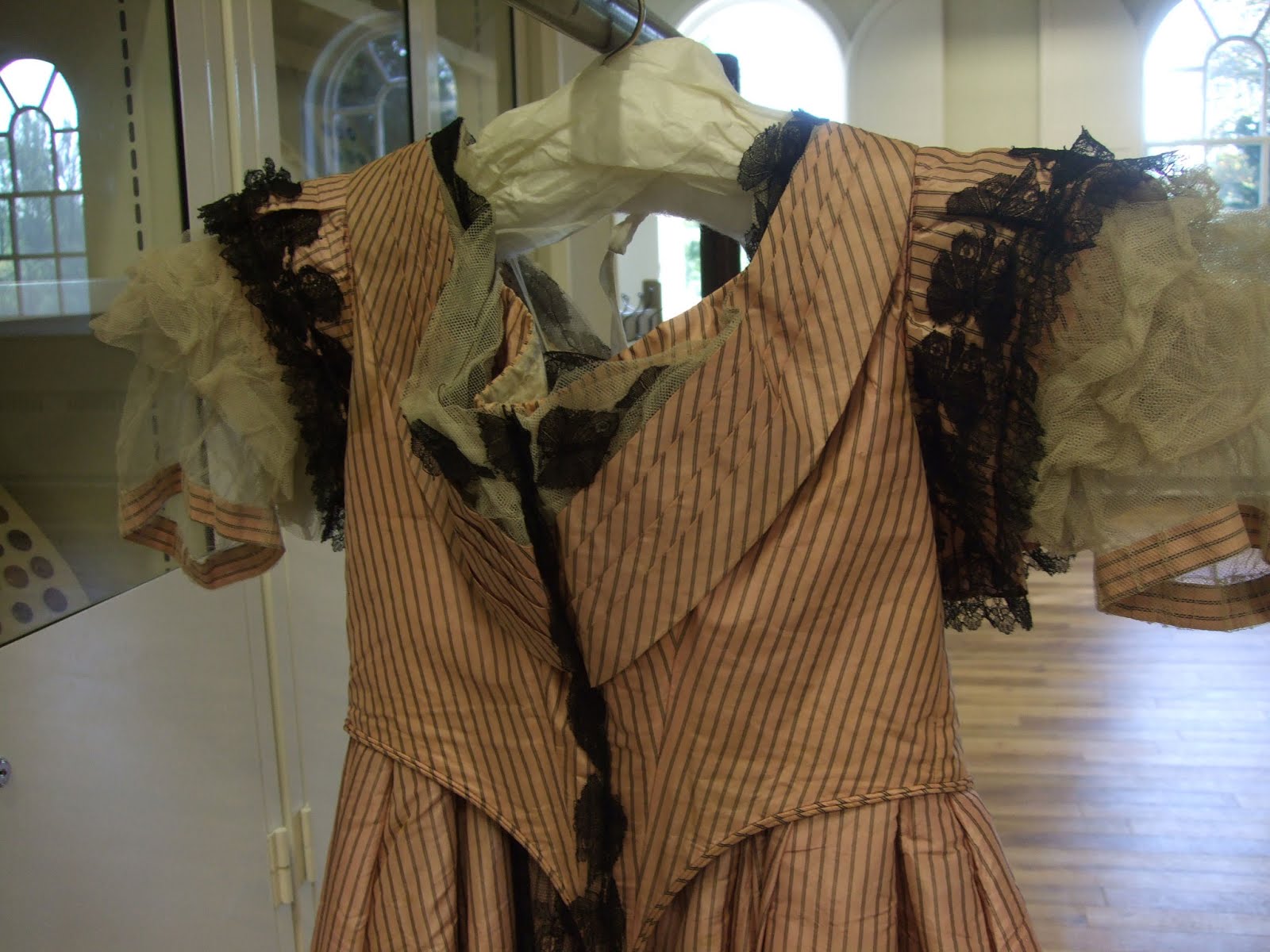
I enjoyed researching this dress.
I started by transferring the pattern from the book to a piece of paper which was easy - nothing too complicated. After I finished on the pattern block, I made the garment in calico used the sewing machine. I started concentrating on the bodice because there were lots of pattern blocks and I needed to see where it joined together.
During my work on the calico, I researched to find similar fabric - pink taffeta with a black fine double stripe but had no luck so I decided to do it myself with a felt pen and tested this on the taffeta fabric that I had found without a stripe. I tried different types of felt pens, and it was not good because the fabric had tiny knots and the felt pen wasn't even through the fabric. I was not very impressed so kept going without the stripe.
The Evening dress is now finished after 3 weeks sewing by hand. I really enjoyed myself working on it without machines.
This is an image of my 1861-4 Evening dress taken by a professional photographer. For the display, I used my repaired 1860 Crinoline.
Monday, 14 January 2013
Tuesday, 8 January 2013
Mid 19th Century Crinoline (Repairs)
I was given this by the Royal House Opera Store in Aberdare, I received it in very bad condition, it was damaged and the crinoline was torn. I wanted to use it for my Janet Arnold 1864 Pink evening dress.
Before
The steel Boning was pointing out and very sharp having no safety tape on the ends, it would not be allowed to be worn by an Actress because it's dangerous and could hurt a person wearing it and possibly could damage the costume.
The shape of Crinoline was not good because the boning was already coming apart!
During...
I had to cut and file down the steel boning with its sharp edges and square corners to a nice curve adding safety tape on the ends. Later on, I had balance the 1860s Crinoline, I was researching the 1860s fashion of Crinolines. I taped the boning to keep it strong so it would not fall apart.
After
The crinoline looks beautiful, I had changed a bit of 1860s crinoline shape and I had smoothed the wire of the steel boning. Later I added the 1864 Evening dress over it ready for some professional Photography.
Individual Project - The Duchess
For my project, I picked a film called 'The Duchess' because I love the 18th Century fashion era and the different costumes and different of fashions like Maternity outfits, early 1800s fashions and workwear.
I picked a costume called 'Fox' because Georgia wore a blue uniform with Fox coloured fur on the puff to support Charles Fox on Election day in 1784. I researched into Georgia's life in late 1700s.
I found the oringial design by Costume Designer Michael O'Connor, I needed to copy the design of this outfit, compare the fabric and pattern block.
During the work on the construction, I first made from calico for fitting and I found a model who was good height and body shape. Later I started making the real costume, always checking the costume fit on the model. I also double checked on the Corset, Waistcoat and Jacket to ensure there were no mistakes or complications.
Finally it's finished and I received a good mark from my Tutor, also I loved the exhibition and display of my work because we had an external examiner as well.
This is my costume work taken by a professional photographer.
I really enjoyed working on this project and I learned a lot and improved my sewing skills. I would have loved to have made the hat but there was lots of work to do and I was not sure where to get a fox's tail. There was also a lot of hand sewing so there was not enough time which I was disappointed by.
Subscribe to:
Posts (Atom)


